
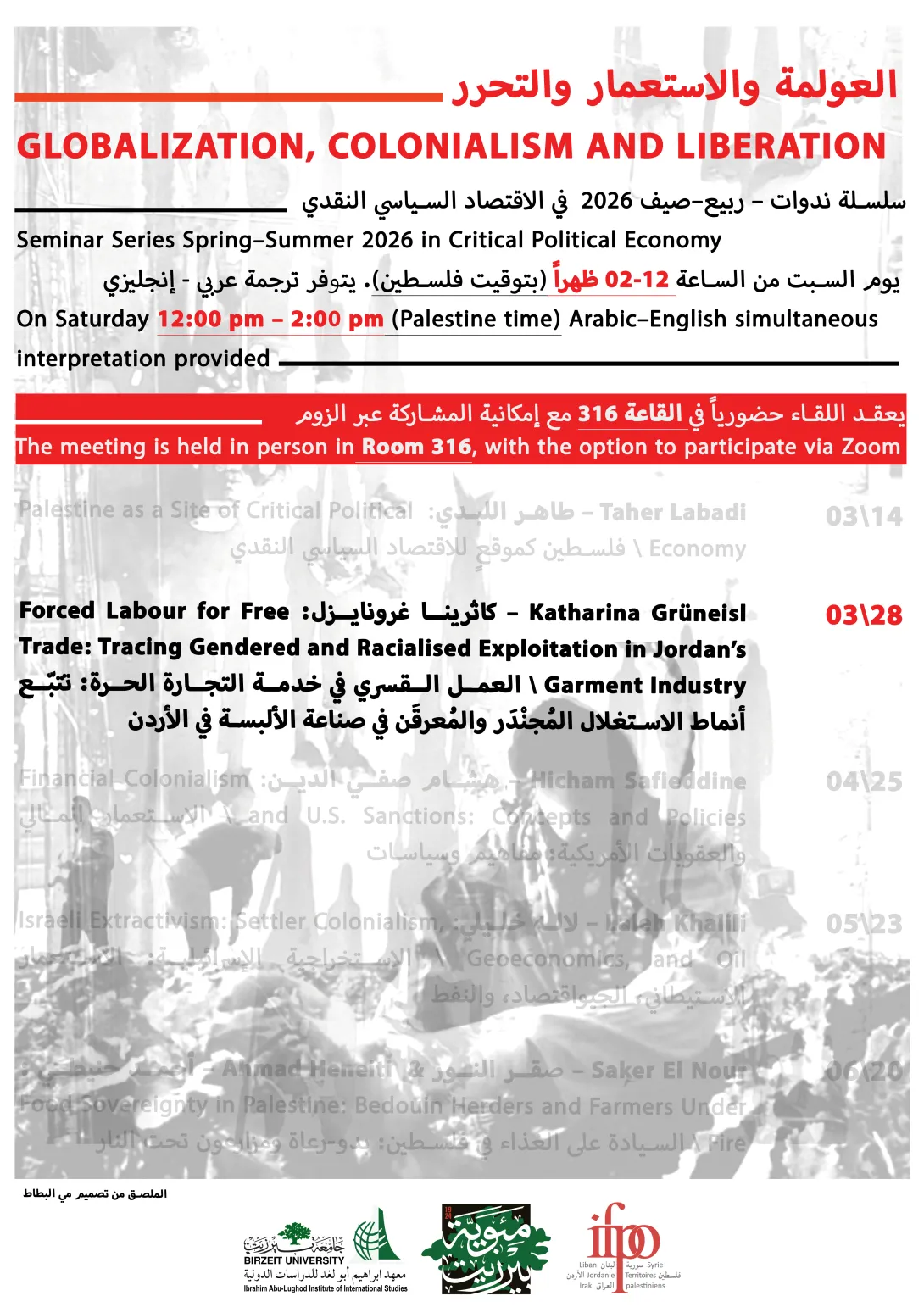
Forced Labour for Free Trade: Tracing Gendered and Racialised Exploitation in Jordan’s Garment Industry
About 80,000 workers—75% of whom are migrants—produce sports and outdoor clothing for major American brands in export-processing zones (EPZs) across Jordan. This talk examines how these zones operate as extra-territorial legal and spatial formations that are partially exempt from national labour protections while simultaneously fulfilling compliance requirements that legitimise their integration into global supply chains.
The first part analyses how the physical and regulatory architectures of EPZs have enabled the consolidation of a quasi-carceral dormitory migrant labour regime. Drawing on 18 months of ethnographic research, I demonstrate that the profitability of “made-in-Jordan” clothing production depends not only on duty-free access to US markets and transnational supply chains, but equally on the spatial confinement and legal disciplining of a predominantly foreign and female workforce. Building on the concept of lawscapes, the talk shows how US trade agreements, Jordanian regulatory adaptations, and the kafala (sponsorship) system co-produce a differentiated labour regime structured through racialised and gendered forms of control.
The second part conceptualises compliance—comprising audit regimes, labour standards, certification mechanisms, and transparency infrastructures—as a central political performance that sustains these exceptional labour arrangements. I show how the ILO’s Better Work Jordan programme, formally mandated to safeguard workers’ rights, plays a key role in staging audit-based transparency while legitimising sector-specific exemptions and obscuring structural coercion. A crisis involving worker suicides and labour unrest in 2023 exposed the fragility of this compliance façade. Rather than prompting structural reform, the episode triggered intensified compliance management and reputational containment. The talk thus reveals how US government agencies, international organisations, and American brands remain deeply implicated in sustaining geopolitical infrastructures of extraction that prioritise trade stability and profit accumulation over labour justice.